Home » Reactive Dyes
Reactive Dyes
Reactive dyes are a class of highly coloured organic substances, primarily used for tinting textiles, that attach themselves to their substrates by a chemical reaction that forms a covalent bond between the molecule of dye and that of the fibre. The dyestuff thus becomes a part of the fibre and is much less likely to be removed by washing than are dyestuffs that adhere by adsorption.
The first fibre reactive dyes were designed for cellulose fibres, and they are still used mostly in this way. There are also commercially available fibre reactive dyes for protein and polyamide fibres. In theory, fibre reactive dyes have been developed for other fibres, but these are not yet practical commercially. The dyes contain a reactive group that, when applied to a fibre in a weakly alkaline dyebath, form a chemical bond with the fibre. Reactive dyes can also be used to dye wool and nylon, in the latter case they are applied under weakly acidic conditions.
The most important characteristic of reactive dyes is the formation of covalent bonds with the substrate to be coloured, i.e. the dye forms a chemical bond with cellulose, which is the main component of cotton fibers.
Fiber reactive dyes are the most permanent of all dye types. Unlike other dyes, it actually forms a covalent bond with the cellulose or protein molecule. Once the bond is formed, what you have is one molecule, as the dye molecule has become an actual part of the cellulose fiber molecule. No wonder you can safely wash a garment that has been dyed in bright fiber reactive colours with white clothing, a hundred times, without endangering the whites in the least - even if it is all different bright colours, or even solid black! In contrast to all other dyes the reactive dyes bind chemically to the textile fibres, significantly improving the product's colour stability and washability. Thus reactive dying of cotton is currently the most widespread textile dying process in the world.
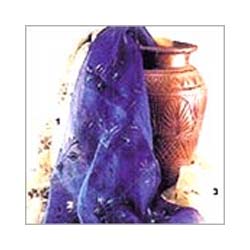
Reactive dyes are a class of highly coloured organic substances, primarily used for tinting textiles, that attach themselves to their substrates by a chemical reaction that forms a covalent bond between the molecule of dye and that of the fibre. The dyestuff thus becomes a part of the fibre and is much less likely to be removed by washing than are dyestuffs that adhere by adsorption.
The first fibre reactive dyes were designed for cellulose fibres, and they are still used mostly in this way. There are also commercially available fibre reactive dyes for protein and polyamide fibres. In theory, fibre reactive dyes have been developed for other fibres, but these are not yet practical commercially. The dyes contain a reactive group that, when applied to a fibre in a weakly alkaline dyebath, form a chemical bond with the fibre. Reactive dyes can also be used to dye wool and nylon, in the latter case they are applied under weakly acidic conditions.
The most important characteristic of reactive dyes is the formation of covalent bonds with the substrate to be coloured, i.e. the dye forms a chemical bond with cellulose, which is the main component of cotton fibers.
Fiber reactive dyes are the most permanent of all dye types. Unlike other dyes, it actually forms a covalent bond with the cellulose or protein molecule. Once the bond is formed, what you have is one molecule, as the dye molecule has become an actual part of the cellulose fiber molecule. No wonder you can safely wash a garment that has been dyed in bright fiber reactive colours with white clothing, a hundred times, without endangering the whites in the least - even if it is all different bright colours, or even solid black! In contrast to all other dyes the reactive dyes bind chemically to the textile fibres, significantly improving the product's colour stability and washability. Thus reactive dying of cotton is currently the most widespread textile dying process in the world.
| Reactive Cold Dyes | FASTNESS PROPERTIES | |||||
| Light | Washing | Perspiration | Hypochlorite | Dischargeability | ||
| Reactive Red M5B Reactive Red - 2 | 4-5 | 4-5 | 3-4 | 1 | P | |
| Reactive Red M8B Reactive Red - 11 | 4-5 | 4-5 | 2 | 4 | P | |
| Reactive Magenta MB Reactive Violet - 13 | 4-5 | 5 | 4-5 | 1 | F | |
| Reactive Orange M2R Reactive Orange - 4 | 5 | 5 | 4 | 4 | P | |
| Reactive Orange M2RJ | 3-4 | 4 | 4 | 4-5 | P | |
| Reactive Gol. Yellow MR Reactive Yellow - 44 | 5 | 4-5 | 4 | 1 | P | |
| Reactive Yellow MR EX H/C Reactive Yellow - 44 | 5 | 4-5 | 4 | 1 | P | |
| Reactive Yellow M3R Reactive Yellow - 36 | 6 | 5 | 4 | 2 | G | |
| Reactive Yellow M4R Reactive Orange - 14 | 5 | 4-5 | 4 | 1 | P | |
| Reactive Yellow M8G Reactive Yellow - 86 | 6 | 4-5 | 4-5 | 1 | G | |
| Reactive Yellow M4G Reactive Yellow - 22 | 6 | 4 | 5 | 1 | G | |
| Reactive Yellow MGR Reactive Yellow - 7 | 6 | 5 | 4-5 | 4-5 | P | |
| Reactive Violet C4R Reactive Violet - 12 | 4 | 3 | 4 | 1 | P | |
| Reactive Violet C2R Reactive Violet - 14 | 3-4 | 3 | 4 | 1 | P | |
| Reactive Blue MR Reactive Blue - 4 | 6 | 5 | 5 | 2 | P | |
| Reactive Blue M2R Reactive Blue - 81 | 6 | 5 | 4-5 | 1 | P | |
| Reactive Blue M2R H/C Reactive Blue - 81 | 6 | 5 | 4-5 | 1 | P | |
| Reactive Navy Blue M3R Reactive Blue - 9 | 5 | 4-5 | 3 | 3 | P | |
| Reactive Blue M4GD H/C Reactive Blue - 168 | 6 | 5 | 3-4 | 2 | P | |
| Reactive Tur. Blue MGN Reactive Blue - 140 | 6 | 4 | 4 | 2-3 | P | |
| Reactive Tur. Blue Ha5G Reactive Blue - 71 | 6 | 3-4 | 4-5 | 3-4 | P | |

The reactive dyes provided by us impart excellent chemical properties and are manufactured by incorporating many technologies. These are available in undermentioned shades, chemical compositions and specifications.
| Reactive 'HE' Dyes | FASTNESS PROPERTIES | |||||
| Light | Washing | Perspiration | Hypochlorite | Dischargeability | ||
| Reactive Yellow HE6G Reactive Yellow - 135 | 4-5 | 4 | 4 | 1 | G | |
| Reactive Yellow HE4R Reactive Yellow - 81 | 5-6 | 5 | 4-5 | 1-2 | G | |
| Reactive Yellow HE4R Reactive Yellow - 84 | 5-6 | 5 | 4-5 | 2-3 | P | |
| Reactive G. Yellow HE4R Reactive Yellow - 81-A | 5 | 5 | 4-5 | 3-4 | P | |
| Reactive Orange HER Reactive Orange - 84 | 3-4 | 4 | 4 | 4-5 | P | |
| Reactive Orange HE2R Reactive Orange - 84-A | 3-4 | 4 | 4 | 4-5 | P | |
| Reactive Red HE3B Reactive Red - 120 | 5 | 5 | 4-5 | 1 | P | |
| Reactive Red HE5B | 4-5 | 5 | 5 | 3 | P | |
| Reactive Red HE7B Reactive Red - 141 | 4-5 | 5 | 5 | 3 | P | |
| Reactive Red HE8B Reactive Red - 152 | 4-5 | 5 | 5 | 3-4 | P | |
| Reactive Green HE 4B Reactive Green - 19 | 4 | 4-5 | 4-5 | 1 | F | |
| Reactive Green HE 4BD Reactive Green - 19A | 4 | 5 | 4-5 | 1 | F | |
| Reactive Black HEBL | 4 | 5 | 4 | 3 | P | |
| Reactive Navy Blue HER Reactive Blue - 171 | 4 | 5 | 4 | 1-2 | F | |
| Reactive Navy Blue HE2R Reactive Blue - 172 | 4 | 4-5 | 4 | 2 | F | |
| Reactive Blue HERD Reactive Blue - 160 | 6 | 5 | 4 | 3 | F | |
| Reactive Navy Blue HEGN Reactive Blue - 198 | 4-5 | 4-5 | 3-4 | 3 | F | |